
Code of Conduct
- Code of Conduct
- 2025 Compliance Review
- Analysis of Results
- Q&A – PPM 128 Non-Compliance
- Q1: Are boards deliberately ignoring Ministry policy?
- Q2: Why focus on signage? Isn’t that just symbolic?
- Q3: Cyberbullying has been in PPM 128 since 2019. Why are so many boards still not using the language?
- Q4: Isn’t it the board, not the Director of Education, who approves policy updates?
- Q5: How many students are actually affected?
- Q6: What will the Ministry do about this?
What Parents Need to Know
What is PPM 128? The Ontario Ministry of Education requires every school board to follow the Provincial Code of Conduct (Policy/Program Memorandum 128). This policy sets the standards for student behaviour, prohibits bullying and cyberbullying, and requires boards to have clear rules, procedures, and reporting mechanisms in place. Boards must also make these policies available to the public and ensure that expectations are visible in schools through signage.
Why does it matter? PPM 128 exists to protect students and create safe, respectful learning environments across Ontario. When school boards do not appear to meet these requirements, parents and students may face real challenges:
- Families may struggle to find the rules or procedures they need to understand how bullying, harassment, or misconduct should be addressed.
- Reporting pathways may be unclear, leaving parents and other community members without confidence in how to seek help or raise concerns.
- Missing signage and weak communication reduce awareness of rights and responsibilities within schools.
What we found: This sampling audit looked at publicly available documents from Ontario school boards and compared them to the requirements of PPM 128. Based on this review, most boards appear not to be fully compliant with all mandatory requirements. For parents, this means there may be gaps between what the Ministry requires and what your local board is actually doing.
If you notice that your board is on the list, please write to your director of Education.
What the Directors of Education and Trustees Need to Know
In Ontario, Boards are obligated to create and maintain Code of Conduct policies and procedures that are publicly accessible:
- Boards are required to establish Code of Conduct policies: “Every board shall establish policies and guidelines with respect to the conduct of persons in schools within the board’s jurisdiction and the policies and guidelines must address such matters and include such requirements as the Minister may specify.” (Education Act, s. 302(1), 2000, c. 12, s. 3)
- Boards must ensure those policies are publicly accessible: “A board shall ensure that a copy of the policies and guidelines it establishes under subsections (1) and (2) are available to the public.” (Education Act, s. 302(9.1), 2007, c. 14, s. 3(2))
- Boards must implement and promote the Minister’s Code of Conduct: “Every board shall take such steps as the Minister directs to bring the code of conduct to the attention of pupils, parents and guardians of pupils and others who may be present in schools under the jurisdiction of the board.” (Education Act, s. 301(3), 2000, c. 12, s. 3)
Concurrently, the Director of Education has specific statutory duties:
- Directors must identify and report potential non-compliance to the Board: “[A] director of education shall, in accordance with the regulations and on behalf of the board of trustees for a board, … immediately upon discovery bring to the attention of the board of trustees any act or omission by the board that, in the opinion of the director of education, may result in or has resulted in a contravention of this Act or any policy, guideline or regulation made under this Act.” (Education Act, s. 283.1(1)(f))
- Directors must escalate if the Board fails to act: “if the board does not respond in a satisfactory manner to an act or omission brought to its attention under clause (f), advise the Deputy Minister of Education of the act or omission.” (Education Act, s. 283.1(1)(g))
Thus, while the Board of Trustees is tasked with creating and maintaining a Code of Conduct, as well as publicly accessible policies and procedures, the Director of Education must escalate when boards fail to develop and implement policies that align with requirements the Ministry may specify.
2025 Compliance Review
Overview
We examined the extent to which Ontario school boards appear to meet selected requirements of Policy/Program Memorandum (PPM) 128: The Provincial Code of Conduct and School Board Codes of Conduct. The purpose is to provide a transparent, evidence-based assessment of school board practices, based solely on documents that were publicly available at the time of review. The ultimate goal is to support accountability and to encourage safe, respectful learning environments consistent with provincial expectations.
Research Question
To what extent do Ontario school boards appear to be following Ministry requirements related to the Provincial Code of Conduct (PPM 128)?
Methodology
- Each school board website was visited between June and August 2025.
- The most recent Code of Conduct, any associated procedures, and related Safe Schools policies were downloaded.
- A structured compliance checklist (see below) was applied to the uploaded documents.
- An automated text-parsing tool extracted relevant requirements. When results were unclear, they were verified through manual human review.
Compliance Checklist
Boards were assessed against a limited set of mandatory requirements outlined in PPM 128. The following items were included:
- Cyberbullying Prohibition – Code of Conduct must explicitly prohibit cyberbullying.
- Implementation Procedures – Boards must develop procedures that describe how schools will implement and enforce the Code of Conduct.
- Public Accessibility – Code of Conduct polices and procedures must be made publicly available (e.g., on a board website). For the purposes of this audit, if a required document was not accessible, it was treated as non-existent.
- Reporting Mechanism – Policies must explain how and to whom members of the school community can report unacceptable behaviour.
- Signage Requirements – Boards must require schools to post signage in school entrances and other visible places that reflects the expectations of the Provincial Code of Conduct.
- Last Updated – The most recent revision date of each document was recorded to assess currency.
This is by no means a comprehensive list of “must” statements; it serves as an initial review to determine high-level alignment with the existing policies.
Scoring Criteria
- A board was considered to appear compliant only if it met all five mandatory requirements (Items 1–5).
- If a board failed one or more requirements, it was recorded as appearing non-compliant based on information available.
- If a required policy or procedure was referenced but not publicly available, it was treated as non-existent for the purposes of this audit.
Disclaimer
These findings are based exclusively on documents that were publicly available on school board websites during the review period (June–August 2025). This audit does not represent a legal determination of compliance or non-compliance. Instead, it presents a policy compliance assessment aligned with the stated requirements of PPM 128 under the Education Act. All source documents have been archived with access dates to ensure transparency and reproducibility.
Analysis of Results
1. Cyberbullying Prohibition (2019, reaffirmed 2024)
Directive: “All members of the school community must not: engage in bullying behaviours, including cyberbullying.”
Finding:
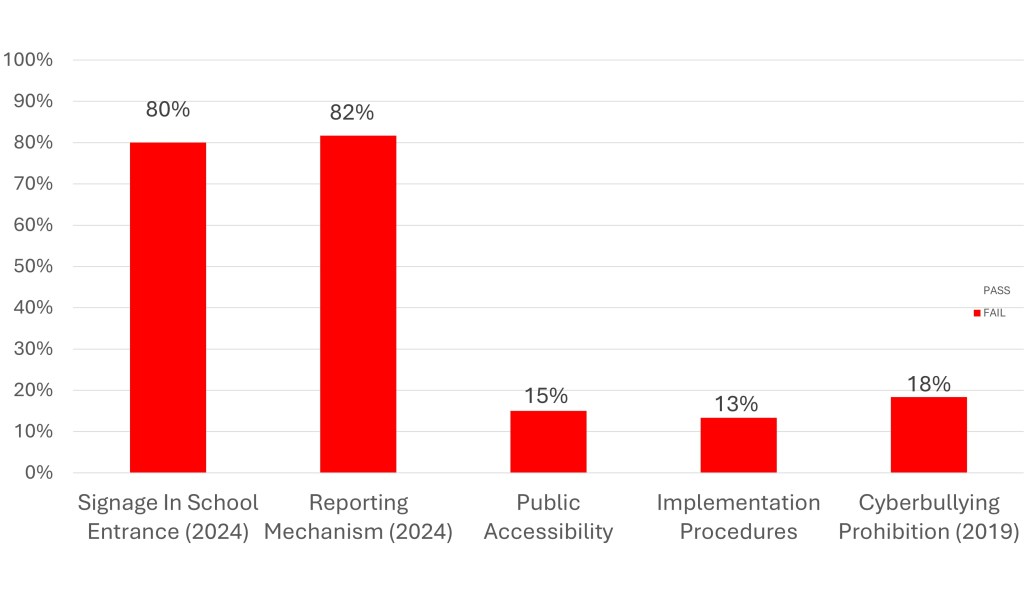
- 11 boards (18%) failed to include an explicit prohibition on cyberbullying in their Codes of Conduct.
- This omission persists five years after the requirement was first introduced in 2019, suggesting entrenched non-compliance.
2. Implementation Procedures
Directive: “Beyond a promotion of the standards, an appropriate implementation of the Provincial Code of Conduct also requires that school boards ensure that the standards of the Provincial Code of Conduct are enforced. As a result, school boards must: develop procedures that set out how their schools will implement and enforce their codes of conduct and all other rules that they develop that are related to the Provincial Code of Conduct standards.”
Finding:
- 8 boards (13%) did not provide implementation procedures.
- In some cases, documents were absent altogether; in others, procedures were vague or buried within unrelated policy frameworks.
3. Public Accessibility
Directive: “School boards must […] make their codes of conduct policies and procedures available to the public, either on the school board’s website or, if that is not possible, in another appropriate manner.”
Finding:
- 9 boards (15%) did not make both their policies and procedures available to the public.
- For the purposes of this audit, inaccessible policies and procedures were treated as non-existent.
4. Reporting Mechanism
Directive: “School boards must: establish a process that clearly communicates the Code of Conduct policies and procedures to all parents, students, principals, teachers, other school staff, and members of the school community in order to obtain their commitment of support. This must include communication of how all members of the school community would appropriately report unacceptable behaviour.”
Finding:
- 49 boards (82%) lacked a clear reporting mechanism for all members of the school community.
- In many cases, board policies provide no practical details on how parents, students, or community members can report unacceptable behaviour.
- In boards where they technically meet this requirement, the reporting option is often a single line indicating concerns should be sent to the principal.
5. Signage Requirements
Directive: “School boards must require that schools post signage in school entrances and other visible places that reflects the behavioural expectations of the Provincial Code of Conduct. The required content of the sign is set out in Appendix A”
Finding:
- 48 boards (80%) failed to include the signage requirement in their policies.
- This undermines the visibility of the Code of Conduct, particularly for parents and visitors who may never otherwise read the written policies.
- The template is provided for the school boards; however, only 20% fully meet the requirement to have signage and to post it in entrances and other visible places.
🧾 Analysis
- While 5 boards appear fully compliant, 5 boards failed outright on every measure. The majority show partial compliance.
- The highest failure rates are in reporting (82%) and signage (80%), two of the most visible and parent-facing requirements.
- The persistence of non-compliance from the 2019 cyberbullying update indicates a systemic leadership problem, not just delay in implementing the 2024 changes.
📊 Best and Worst Performers
From the 60 English boards reviewed, a handful stand out at both extremes.
Boards with Apparent Full Compliance (100%)
- Avon Maitland DSB
- Bluewater DSB
- Brant Haldimand Norfolk CDSB
- Ottawa-Carleton DSB
- Thunder Bay Catholic DSB
Note: This may change if a full audit involving all “must” statements in the PPM is completed.
Boards with Apparent Complete Non-Compliance (0%)
- Bruce-Grey Catholic DSB
- Greater Essex County DSB
- London District Catholic School
- Simcoe Muskoka Catholic DSB
- Toronto Catholic DSB (currently under Ministry supervision)
✅ Conclusion
This audit demonstrates widespread and serious failures in implementing PPM 128 across Ontario school boards. While a small number of boards appear to show full compliance, most boards are either partially compliant or wholly non-compliant.
The Ministry’s directives use unequivocal language (“must”), leaving no ambiguity. Yet the data show that nearly two million Ontario students are attending schools at boards without the full protections guaranteed by provincial policy, based on publicly available documents.
In Ontario’s governance framework, the Ministry of Education sets provincial policy through Policy/Program Memoranda; Boards of Trustees establish local policy consistent with those directives; and Directors of Education implement and monitor those policies. When gaps arise, the Director must alert the Board, and the Board must take corrective action to restore compliance. Identifiying issues is the first step, which has now been completed through this process.
Q&A – PPM 128 Non-Compliance
Q1: Are boards deliberately ignoring Ministry policy?
A: The evidence suggests implementation is delayed or incomplete, but does not explore intent. What matters is effect: Ministry directives have not been carried out, and students remain unprotected.
Q2: Why focus on signage? Isn’t that just symbolic?
A: Signage is more than a symbol. It makes behaviour expectations visible to everyone — students, parents, staff, and visitors — the moment they enter a school. It was secured by teachers as part of a safety measure, and it signals that schools take the Code of Conduct seriously. The ETFO felt strongly enough about it that it was considered an important win in the most recent round of bargaining. The fact that 90% of boards haven’t acted shows a deeper problem: if boards can’t even post signs, how can parents trust them to enforce the Code?
Q3: Cyberbullying has been in PPM 128 since 2019. Why are so many boards still not using the language?
A: That’s a question to ask your local school board. Nearly five years after the requirement, almost 20% of English boards still haven’t updated their Codes of Conduct to include cyberbullying or a variation on it (ex. online bullying). It’s unclear why this has been missed, considering recent high-profile cases in North America.
Q4: Isn’t it the board, not the Director of Education, who approves policy updates?
A: In Ontario’s governance framework, the Ministry of Education sets provincial policy through Policy/Program Memoranda; Boards of Trustees establish local policy consistent with those directives; and Directors of Education implement and monitor those policies. When gaps arise, the Director must alert the Board, and the Board must take corrective action to restore compliance. If this does not occur, the Deputy Minister of Education must be notified.
Q5: How many students are actually affected?
A: Based on our review, nearly two million Ontario students attend schools under boards that are not in full compliance with either the 2019 or 2024 requirements of PPM 128. That means students, parents, and teachers across the province are denied protections the Ministry has already mandated.
Q6: What will the Ministry do about this?
A: It is unknown how the Ministry will proceed.
 School Board Research