
April 13, 2026
The headline
On Monday, April 13, 2026, Ontario Education Minister Paul Calandra tabled the Putting Student Achievement First Act, 2026 at Queen’s Park. The government released an accompanying Media Briefing the same day setting out the full scope of the bill (Ontario Ministry of Education, 2026a). The Act is expansive — it reaches trustee accountability, executive leadership, budget approval, central bargaining, capital projects, board communications, classroom resources, secondary-school assessment, teacher education, child-care registration, and the dissolution of both the Languages of Instruction Commission of Ontario and the Higher Education Quality Council of Ontario.
But the centre of gravity is school board governance, and on that question the government’s own Media Briefing is unusually candid about the diagnosis. The trustee system is not working:
“Despite established governance structures and controls, trustees have fallen short in providing adequate oversight and leadership, leading to infighting and governance dysfunction that undermine the quality of education and public trust” (Ontario Ministry of Education, 2026a, p. 9).
“For too long, too many school board trustees have consistently failed to act in the best interests of students, teachers and parents” (Ontario Ministry of Education, 2026a, p. 7).
The Minister, in the same document, frames the Act as the response:
“Ontario’s education system must remain focused on its core responsibility: student success. In some school boards, that focus has been lost, and students are paying the price” (Calandra, 2026, as reported by CBC News, 2026).
Read together, the Briefing and the Act do three things at once: they identify trustees as the governance failure point, they narrow what trustees can do, and they preserve the single decision that matters most — who runs the board. That contradiction is the story.
What the Act does — the six-part governance package
The Strengthening Governance and Accountability chapter of the Act contains six initiatives (Ontario Ministry of Education, 2026a, pp. 6–17):
1. Trustee accountability. Honoraria are capped at a maximum of $10,000. Discretionary expenses are restricted; boards cannot reimburse trustees for personal electronics, trustee-association membership fees, non-essential conferences, or meal and hospitality expenses (p. 8). The trustee complement is set to a range of 5 to 12 across district school boards, which in practice affects only the Toronto District School Board — reducing it from 22 to 12 and aligning it with the Toronto Catholic DSB (p. 8). Oversight of school board subsidiaries — transportation consortia, foundations, temporary organizations — is expanded (p. 8). These trustee-accountability measures apply to all boards.
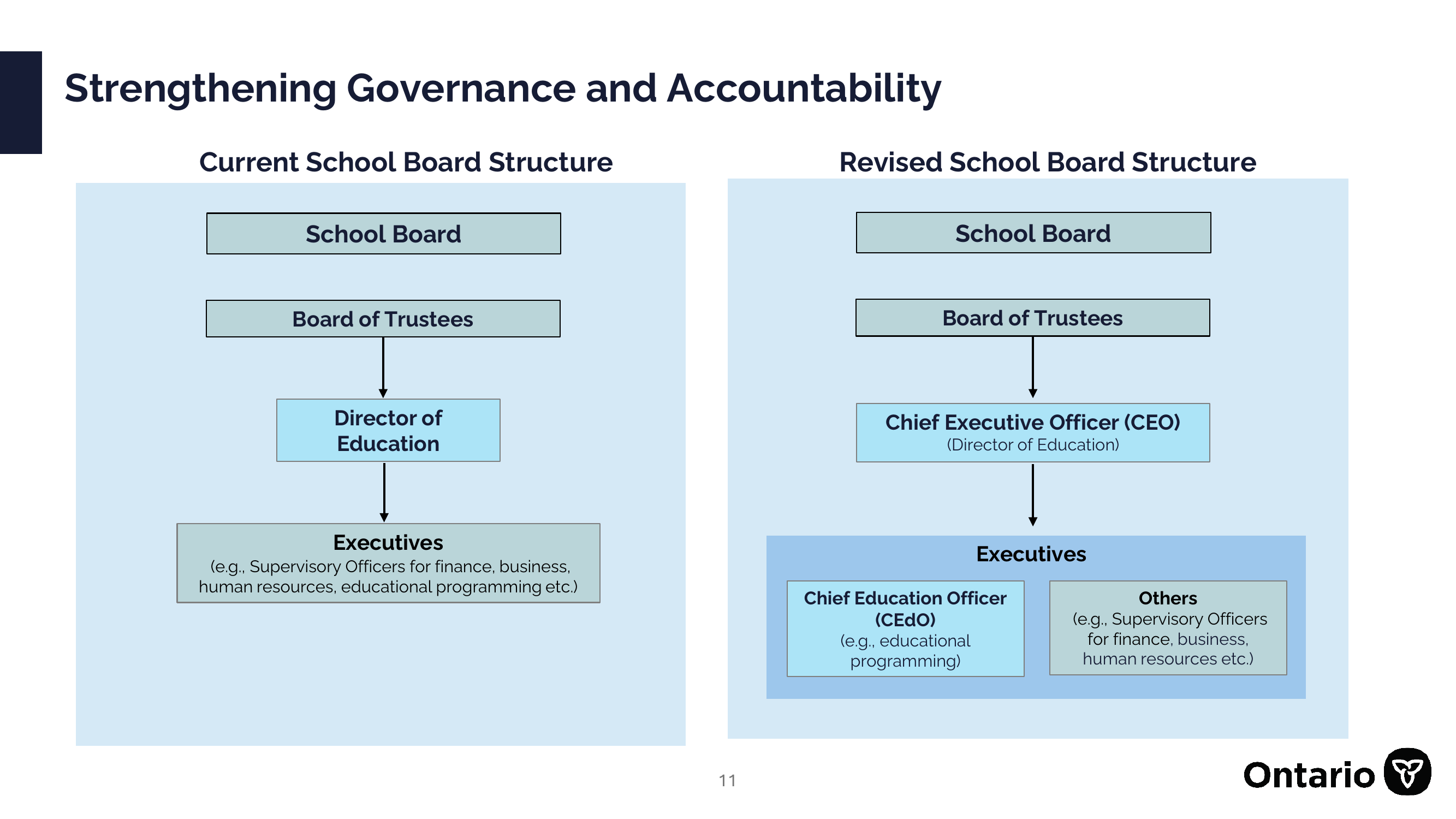
2. New executive structure. The Director of Education is renamed Chief Executive Officer (CEO), with required “business qualifications” for financial and operational oversight. A Chief Education Officer (CEdO) role is created for pedagogical leadership, requiring Ontario College of Teachers certification or equivalent (pp. 10, 12). This applies to English public and English Catholic DSBs only; French-language DSBs are out of scope.
3. Budget. Budget development is “led by the CEO” rather than by trustees (p. 13). Where trustees cannot reach agreement, budget matters are “referred to the Minister for decision” (p. 13) — not returned to the board for further deliberation. The CEO is also made Secretary and a non-voting member of the governing board, and “certain trustee resolutions or motions, such as those with financial implications,” require the CEO’s confirmation before they take effect (p. 10).
4. Central bargaining. The Council of Ontario Directors of Education is designated the central employer bargaining agency for English public and English Catholic DSBs. CEOs ratify central agreements. The Ontario Catholic School Trustees’ Association becomes an observer at central bargaining, with denominational matters handled locally. In English public DSBs, CEOs ratify local agreements; in English Catholic DSBs, CEOs and trustees ratify jointly (p. 15). French-language boards continue under their existing trustees’ associations.
5. Capital projects. The Minister can oversee, redirect, or cancel capital school projects, and can appoint a third party to manage an individual project without supervising the entire board (p. 16).
6. Communications. The Minister is empowered to issue policies and guidelines governing board communications made in the name of the board (official website, emails, newsletters, social media accounts). Personal communications by trustees acting as elected officials are explicitly outside scope (p. 17).
Alongside the governance package, the Act introduces mandatory written exams for Grades 9–12, makes attendance and participation worth 15 per cent of the final mark in Grades 9–10 and 10 per cent in Grades 11–12, eliminates the school climate survey requirement, requires every board to establish a Student and Family Support Office by September 1, 2026, mandates use of provincially approved learning resources delivered through Supply Ontario for 2026–27, compresses teacher education to a twelve-month Bachelor of Education, dissolves the Languages of Instruction Commission of Ontario, and winds up the Higher Education Quality Council of Ontario with its mandate folded into the Ministry (Ontario Ministry of Education, 2026a, pp. 19–24).
Who hires the CEO?
The trustees — the same trustees the government just spent nine pages indicting.
This is the part of the Act that does not work.
The Media Briefing is explicit, in a single bullet on page 10:
“Keeping the authority to hire the CEO with the board of trustees but requiring Ministerial approval for termination. This would help prevent trustee reprisals or dismissals of school board leadership while they are carrying out their responsibilities” (Ontario Ministry of Education, 2026a, p. 10).
The hiring decision stays with the trustees. The Act narrows what trustees can do once the hire is made — it adds Ministerial termination approval, strips trustees of budget authorship, installs the CEO as Secretary with confirmation authority over financially consequential motions, removes labour negotiations from trustee control, and caps trustee honoraria — but the one decision that determines whether a board will be well run, or whether it will produce the pattern of dysfunction the government just documented across the boards currently under supervision, is left exactly where it sits under s. 279 of the Education Act as currently in force.
The internal contradiction is not subtle. On page 7, the government tells the reader that “too many school board trustees have consistently failed to act in the best interests of students.” On page 9, it says trustees “have fallen short in providing adequate oversight and leadership.” On page 10, it keeps those same trustees as the hiring authority for the board’s chief executive.
This is the governance equivalent of replacing the door locks on a building while leaving the same key-cutter in charge. The reform narrows consequences and concentrates day-to-day power in the CEO. It does not touch the selection judgment that produced the problem.
The “CEO can serve as CEdO” loophole
The briefing contains a second provision that further weakens the credentialing story:
“Allowing the CEO to serve as CEdO if qualified in both areas or appoint another qualified individual” (Ontario Ministry of Education, 2026a, p. 10, repeated at p. 12).
Read carefully, this means the Act does not actually require boards to have two executive leaders. It requires two roles, which one person can fill. The government’s own org chart on page 11 labels the new top role “Chief Executive Officer (CEO) (Director of Education)” — the title transfers, the person can transfer, and where the incumbent holds Ontario College of Teachers certification — which is typical, given existing supervisory-officer qualification requirements — and whatever undefined “business qualifications” the regulations will eventually specify, the board can simply redesignate the same person into both boxes on day one. The “two specialized roles” framing on page 12 collapses into a single role with two hats.
This is not a hypothetical. The briefing is silent on transition arrangements for incumbent Directors of Education. There is no grandfathering clause, no credential-acquisition window, no severance regime, and no forced reclassification described in the document. The only reference to transition is a single line — “Working with school boards to support implementation” (p. 10) — and an organizational diagram that places the existing Director of Education inside the new CEO box. The most straightforward reading is that current Directors are deemed to be CEOs, appoint themselves as CEdOs where they hold teaching qualifications, and carry on.
If that reading is correct, the bill changes the title, the budget authorship, the bargaining structure, and the termination process. It does not change who runs the board.
What the Act does not do
Trustee oversight of policy development is still not addressed. Boards have been failing to oversee administrative policy work — Codes of Conduct under PPM 128, Bullying Prevention and Intervention Plans under PPM 144, Board Improvement and Equity Plans, Director performance reviews tied to student outcomes. The Act tightens trustee expense rules and removes their grip on budgets and bargaining, but says nothing about the policy-oversight function — the thing trustees are statutorily supposed to do. A board that currently approves a non-compliant Code of Conduct will continue to approve a non-compliant Code of Conduct. A board that currently rubber-stamps a BIEP without interrogating the evidence base will continue to do so.
“Student achievement” is not operationalized. The Act is named for student achievement and creates an executive role dedicated to it, but the Media Briefing does not specify the performance metrics, reporting cadence, or compliance consequences that will govern the CEdO. The Ministry’s own governance diagnosis (p. 7) and its policy response (the new roles, the CEO confirmation power, the central bargaining model) are all focused on financial and operational control. The achievement side of the Act is announced but not instrumented.
PPM compliance has no standardized regime. Nothing in the Briefing creates a provincial compliance and reporting mechanism for Program/Policy Memoranda. If PPM 128 and PPM 144 were inconsistently implemented before this Act, they will be inconsistently implemented after it, because the Act does not create the audit, reporting, or consequence regime required to change that.
“Business qualifications” are undefined. The term appears in the briefing but is not defined in the document reviewed. The Briefing is explicit that the qualifications will be set “if the proposed legislation is passed and related regulations are made” (p. 10). The specification is therefore left to regulation and Ministerial discretion, which means it is also revisable without returning to the Legislature. For any up-and-coming superintendents, attending a weekend MBA program will ensure they are primed for the CEO position that opens up. Effectively – another qualification, same pool of candidates.
A provincially standardized trustee code of conduct is not in the Act. The Italy-trip and TCDSB-iPad incidents catalogued in the Briefing (p. 7) point to a code-of-conduct problem. The Act responds with expense caps and honoraria limits rather than with a provincially legislated code of conduct enforceable through a provincial integrity mechanism.
What the Act does do — and what is substantively new
Three provisions are genuinely consequential and should not be minimized:
First, the CEO’s confirmation authority over trustee motions with financial implications (p. 10) is a real shift of power from the elected body to the administrative head. It is the practical mechanism by which the Act transforms trustees from decision-makers into a consultative body on financial matters.
Second, referring trustee budget impasses to the Minister (p. 13) removes the most consequential strategic lever trustees currently hold — the ability to refuse to pass a budget — and redirects it upward rather than back to the board.
Third, the central bargaining model, designating CODE as the employer agent and requiring CEO ratification (p. 15), is the most complete structural removal of trustees from a decision area in the entire Act.
The pattern across all three is consistent: trustees retain their formal role but lose the decisions. What they do not lose is the hire.
Reaction
The ETFO and the AODA Alliance have opposed the broader takeover regime preceding this Act, framing it as a “distraction from chronic underfunding” (CBC News, 2026) and as a false dilemma between eliminating elected trustees and maintaining the status quo (AODA Alliance, 2026). Opposition Education Critic Chandra Pasma (NDP) has previously described the supervision regime as a “power grab” (as cited in CBC News, 2026). Debbie Kasman’s May 2025 open letter called the existing governance structure “long overdue for a complete government overhaul” (Kasman, 2025).
No reaction from OPSBA, OCSTA, or the Council of Ontario Directors of Education to the tabled Act was available in sources accessible at publication. CODE’s position, in particular, warrants watching: the Act transfers substantial new responsibility to its members (budget authorship, central bargaining ratification, motion confirmation) and would be the first significant expansion of Director/CEO authority under s. 279.
Bottom line
The Putting Student Achievement First Act, 2026 is accompanied by an unusually candid diagnostic document. The Media Briefing names the problem: trustees have failed to oversee the boards they are elected to govern. The Act’s response to that diagnosis is to narrow trustee authority in nearly every direction — honoraria, expenses, budget authorship, labour negotiations, communications — while preserving the one authority that would actually change board outcomes, which is the authority to hire the person who runs the board.
A reform that names trustees as the governance failure and then entrusts the same trustees with the selection of the chief executive is not a student-achievement reform. It is a centralization reform that moves the executive closer to the Minister and further from the elected body, without solving the selection problem that produced the dysfunction in the first place. The credentialing requirement is soft (set by regulation, revisable), the “two-role” structure can be collapsed into one person, and incumbents appear to be grandfathered by implication.
School Board Research will be watching three things in the weeks ahead: (1) the text of the regulations defining “business qualifications,” including whether they grandfather incumbent Directors; (2) the first application of the Minister’s new authority to decide a trustee budget impasse; and (3) whether the first Code of Conduct and BIEP cycles under the new regime produce measurable compliance improvement. Structure is not outcome. The Act concentrates authority. Whether it produces better outcomes for students is a separate question, and on the evidence of the Briefing itself, the answer is not obvious.
References
AODA Alliance. (2026, March 11). Education Minister Calandra wrong to only consider two options, abolishing elected school board trustees or simply maintaining the status quo unchanged. https://www.aodaalliance.org/whats-new/education-minister-calandra-wrong-to-only-consider-two-options-abolishing-elected-school-board-trustees-or-simply-maintaining-the-status-quo-unchanged/
Calandra, P. (2026, April 13). [Minister’s statement on the tabling of the Putting Student Achievement First Act, 2026]. Reported in CBC News, Ontario capping number of school trustees per board, creating new oversight roles.
CBC News. (2026, April 13). Ontario capping number of school trustees per board, creating new oversight roles. https://www.cbc.ca/news/canada/toronto/ontario-school-board-legislation-9.7161639
Education Act, R.S.O. 1990, c. E.2, s. 279. https://www.ontario.ca/laws/statute/90e02
Kasman, D. (2025, May 14). An open letter to Hon. Paul Calandra, Minister of Education — school board governance in Ontario: Long overdue for a complete government overhaul. https://debbielkasman.com/blog/2025/5/14/an-open-letter-to-hon-paul-calandra-minister-of-education-school-board-governance-in-ontario-long-overdue-for-a-complete-government-overhaul
Ontario Ministry of Education. (2026a, April 13). Media briefing: Putting Student Achievement First Act, 2026. https://news.ontario.ca/assets/files/20260413/8efad13499c9e1882b1c908d90030ba0.pdf
Supporting Children and Students Act, S.O. 2025 (Bill 33). https://www.cbc.ca/news/canada/ontario-schools-bill-33-explained-9.6986163
Leave a Reply