
October 8, 2026
The rule that sets Director of Education pay in Ontario counts size and complexity. It has never counted results.
Summary
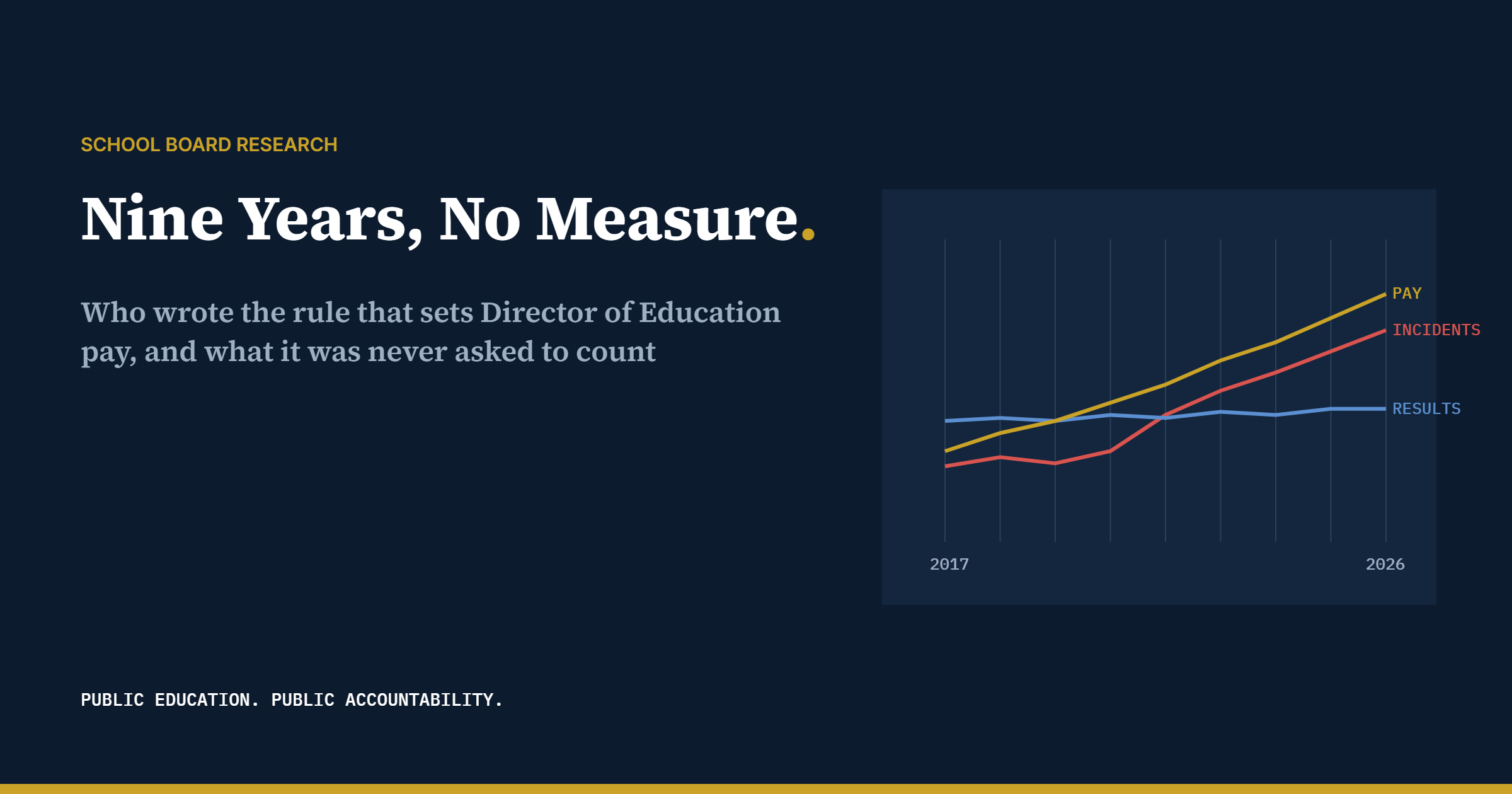
A child who started junior kindergarten in Ontario in September 2017 is in Grade 8 this year. That September, the province’s school boards finished deciding how much to pay the people who run them. Since then, the number of violent incidents that boards report to the Ministry of Education has gone from 2,499 a year, in 2018-19, to 4,424, in 2023-24. In the four years for which results can be compared, the share of Grade 3 and Grade 6 students meeting the provincial standard has moved from 69.2 per cent to 71.0. The salary paid for the Director of Education’s post has risen at 71 of 72 boards, by a median of 25 per cent.
The three facts are unconnected. That is not an accident of the data. It is how the rule that sets a Director’s pay was written.
The agency that tests whether Ontario students can read, write and do mathematics is named in 30 of the 32 executive compensation programs that school boards have posted. It is there as an organization whose executive pay helps set the Director of Education’s salary. Its results appear in none of them.
Since 2017 the salary range for every Director of Education in Ontario has been set by a single province-wide program, referred to here as the Mercer framework after the consulting firm that worked on it. This article traces where it came from, using the documents that record its making. Four findings follow from them.
- The framework was not new in 2017. Mercer had built an executive compensation framework for the Council of Ontario Directors of Education before the legislation existed, and the 2017 sector committee instructed Mercer to work from it. The seven pay levels that now apply to every board were, in the council’s words, “consistent with the CODE Framework developed and endorsed by CODE”.
- The committee that adopted it had eleven member organizations. Six were associations of the directors and supervisory officers whose pay it sets. The committee was chaired by the executive director of the public school boards’ association, and the Ministry of Education endorsed the result on 31 August 2017.
- The framework places each board on one of seven levels using five measures of size and two of complexity. A search of the 32 complete programs found no reference to bullying, graduation rates, test results or accessibility. Student achievement appears only as a reason to pay executives well.
- When the government raised performance-based pay in 2018, the directors’ council replied that there was “little precedent” for it and asked that the framework be kept and salaries not reduced. No measure of results has been added since. The salary paid for the Director’s post has risen at 71 of 72 boards, by a median of 25 per cent.
1. Introduction
A Director of Education is the chief executive of a school board, hired by its elected trustees. Since May 2026, English-language boards have been required to refer to the Director as the chief executive officer (Education Act, s. 283.0.1 (2)); the Act and the compensation documents still use the title director of education, and so does this article. The Education Act requires every board to promote student achievement and well-being, to promote the prevention of bullying, and to monitor and evaluate the performance of its Director (Education Act, s. 169.1 (1)). Boards are also bound by the Accessibility for Ontarians with Disabilities Act, 2005.
How much the Director is paid is decided under a different statute, by a different instrument, written by different people. This article asks three questions of that instrument. Who wrote it? What does it count? What happened when someone proposed that it count results?
2. A freeze, an Act, and a framework that already existed
Executive pay at Ontario school boards, hospitals, colleges and universities was frozen from 31 March 2012 under the Broader Public Sector Accountability Act, 2010 (Canadian HR Reporter 2016). The freeze did not hold everywhere. In March 2015 the Minister of Education ordered audits of all 72 boards to identify senior staff who had received increases during the freeze (Howlett 2015).
The province’s longer-term answer was the Broader Public Sector Executive Compensation Act, 2014, in force from 16 March 2015 (PwC 2025, 14). The Act allowed the government to set compensation frameworks by regulation. The first, Ontario Regulation 304/16, came into force on 6 September 2016. It required each employer to write an executive compensation program, to compare its executive positions with at least eight comparable organizations, and to cap pay at the 50th percentile of that group (PwC 2025, 14; TVDSB 2017, 11). The regulation said how pay was to be benchmarked. It did not require any measure of results.
The school board sector did not start from a blank page. In February 2017 the Steering Committee formed to write the sector’s program reported that Mercer (Canada) Limited was “the organization that developed the original Executive Compensation framework for CODE”, the Council of Ontario Directors of Education, and that the committee had “agreed to continue to work with Mercer”. Mercer’s consultants, the report said, “will use the original executive compensation framework developed for directors prior to the BPS legislation” (Executive Compensation Steering Committee 2017). Later that month the council’s chair told its members that the committee had tentatively agreed a framework for Directors with “7 Levels consistent with the CODE Framework developed and endorsed by CODE”, with a top salary for Level 7 “based upon 18 comparators (10 Education Sector and 8 Broader Public Sector)”, cascading “down from Level 7 to Level 1 in regular % discounts”, and allowing “for upside growth that the Steering Committee believes to be reasonable” (CODE 2017).
School Board Research has not seen the original CODE framework. It was not published, and no copy has been found on the council’s website, in the Internet Archive or in any board’s public record. What the 2017 documents establish is its origin and its carry-over. A framework commissioned by the directors’ own council, for its members, became the starting point for the one the province adopted (Figure 1).

3. One program, 72 boards
School boards did not write 72 separate programs. They wrote one. In the words of the program itself, the boards “worked through a Steering Committee to develop a Province-wide sector-based proposed Executive Compensation Program”, and the work “was completed in consultation with Mercer (Canada) Limited, an independent consulting firm that specializes in executive compensation” (TVDSB 2017, 2-3). Each board then posted the same document under its own name, held a 30-day public consultation, and sought approval from the Ministry of Education.
The programs list the committee’s members (Figure 2). Of eleven organizations, six are associations of directors of education and supervisory officers: the Council of Ontario Directors of Education, the Public Council of Ontario Directors of Education, the English Catholic Council of Directors of Education, the Conseil ontarien des directrices et des directeurs de l’éducation de langue française, the Ontario Catholic Supervisory Officers Association and the Ontario Public Supervisory Officers Association. Four are associations of trustees and boards, and one represents French-language education managers (SGDSB 2017, 5). The committee was chaired by the executive director of the Ontario Public School Boards’ Association (Executive Compensation Steering Committee 2017). The program describes its method in five steps, three of them “consensus-based”, beginning with the collection of “organization, job, and compensation information from Directors of Education, Associate Directors, Supervisory Officers, and other executives” by questionnaire (SGDSB 2017, 7). The people whose pay the framework sets were, through their associations, the largest group at the table, and they supplied the data. That is a matter of record in the documents and was not concealed.

On 31 August 2017 the Ministry of Education endorsed the framework. The Minister wrote to the trustee associations that “a provincial framework that is supported by both the sector and the ministry is an important first step”, and that the Ministry was “committed to adjusting the Grants for Student Needs” to recognize each board’s finalized program (Hunter 2017). The Ministry later provided about $8 million for the executive compensation increases introduced in 2017-18 (Ontario Ministry of Education 2019).
The committee’s central product was the Executive Accountability and Complexity Matrix, which sorts the 72 boards into seven levels. The program describes it as using “a set of five Core and two Non-Core factors to rate, rank, and review each school board based on accountabilities, size, and other complexity criteria”, and says the number of levels “was also tested using Mercer’s proprietary job evaluation system, International Position Evaluation” (TVDSB 2017, 10). Figure 3 reproduces the matrix as the boards published it.

Each level carries a list of comparator organizations, with “a 75% weighting on education-focused organizations” (TVDSB 2017, 12), and a salary range. The range for a Director runs from $166,000 to $198,000 at Level 1 and from $255,000 to $316,000 at Level 7 (Figure 4). The ranges applied from 1 September 2017.

A level is not fixed by the core factors alone. A board may ask the Ministry for a higher level on the strength of the two non-core factors, geographic complexity and community partnerships. Thames Valley told its community that its trustees had “requested approval from the Ministry of Education for an improvement from the initial placement of our Board in Level 5 of the Executive Compensation Framework, up to Level 6” (TVDSB 2017, 2). In the published grid, that request moves the Director’s range from $224,000 to $277,000 up to $239,000 to $296,000: $15,000 more at the bottom of the range and $19,000 more at the top, for the same board, the same schools and the same students. Of the 32 complete programs reviewed, 11 recorded a level above the one the core factors produced. None described a way for a level to be lowered.
4. What is counted, and what is not
Every core factor in the matrix is a count of something the board has: dollars, buildings, students, teachers, superintendents. The two non-core factors describe the board’s territory and its partners. A board’s level, and so its Director’s salary range, is fixed by how large and how complicated the organization is.
The programs are equally clear about what the ranges were built around. The framework was designed “to reduce the compression and attract school board employees to executive positions”, by keeping “approximately a 5% differential between the executive minimum and the maximum Principal salaries”, and it “may need to be revisited based on future collective bargaining” (OCDSB 2018, section 8). Two reference points therefore drive the framework: the size of the board, and the pay of the staff below the executive. Neither moves when students learn more or less, or when schools become more or less safe.
Three things are not in the matrix. They are the three things School Board Research examines at every board, because each is a duty the law places on the board.
Student achievement. The Education Act makes promoting student achievement and well-being the first duty of every board (Education Act, s. 169.1 (1) (a)). The matrix has no row for it. The programs do mention achievement, as a justification: the compensation philosophy states that “student achievement and success is a critical public service and requires innovative leadership to further advance the current public education system” (OCDSB 2018, section 5). The sentence gives a reason to pay executives well. No result is attached to it.
Student safety. The same section of the Act requires every board to promote a positive school climate and the prevention of bullying (Education Act, s. 169.1 (1) (a.1)-(a.2)). The Ministry sets out what each board’s code of conduct and bullying prevention plan must contain in Policy/Program Memoranda 128 and 144. The matrix has no row for any of it.
Accessibility. School boards are subject to the Accessibility for Ontarians with Disabilities Act, 2005 and its Integrated Accessibility Standards regulation (O. Reg. 191/11). The matrix has no row for that either.
To test whether these subjects appear anywhere else in the documents, School Board Research searched the full text of the 32 complete programs that boards had posted as of April 2026, in English and in French. Table 1 gives the result.
Table 1. What a search of 32 board executive compensation programs found
| Term searched | Programs containing it | How it is used |
|---|---|---|
| Bullying | 0 of 32 | Not used |
| Graduation rates, test scores, provincial standard | 0 of 32 | Not used |
| Accessibility | 0 of 32 | Not used. The word “accessible” appears in two programs, once for a school that can be reached only by rail or air and once for education in communities without fibre-optic service |
| Safety | 3 of 32 | Once in each: workplace health and safety as a staff portfolio; health and safety agencies listed as community partners; and student health and safety cited in a request for a higher pay level |
| Achievement | 32 of 32 | As a reason for competitive executive pay. One program also describes its own board’s results |
| EQAO | 30 of 32 | In the list of comparator organizations whose executive pay is used as a benchmark |
The last row is the one to read twice. The Education Quality and Accountability Office is present in 30 of the 32 programs, in the list of organizations whose executive pay is used to benchmark the Director’s. Its results are not there at all. None of the 32 programs contains an outcome factor in setting the level, and none contains a performance pay element of any kind. Student achievement, student safety and accessibility are not weighed lightly in this framework, or weighed badly. They are not weighed.
5. When results were raised
The 2017 ranges had been in effect for less than a year when the rules changed. On 13 August 2018, Ontario Regulation 406/18 revoked Ontario Regulation 304/16 and capped the salary for each executive position at the amount “actually being earned by the occupant of that position” on that date (O. Reg. 406/18, s. 3 (3)). A ministry-commissioned report later described the effect as “freezes on salary and all other elements of compensation as of this date” (PwC 2025, 15). The freeze stopped further increases. It did not reverse the ones already made. When the Ministry suspended the executive compensation funding planned for 2018-19, it confirmed that “the increases introduced in 2017-18 will continue to be provided on an ongoing basis as these increases are now built into school board cost structures” (Ontario Ministry of Education 2018).
The government then reviewed executive compensation across the public sector and raised the question of tying pay to results. In October 2018 the Council of Ontario Directors of Education replied that it was “concerned given that there is little precedent to be found that confirms the positive impact of performance-based compensation for district leaders on student achievement and well-being or leadership quality” (CODE 2018). The council said it was open to exploring the idea through a working group. It asked that the existing framework “be maintained and serve as the base upon which a performance-based compensation program is added”, and that “there be no reduction in current executive salaries” (CODE 2018).
The law moved part of the way. In 2019 the Act was amended to allow a framework to authorize rules on the use of “performance assessment indicators in determining a designated executive’s compensation” (Broader Public Sector Executive Compensation Act, 2014, s. 6 (4)). The framework regulation contains no such authorization. The same amendments allowed a framework to authorize exemptions, and provided that the part of the Legislation Act, 2006 governing the filing and publication of regulations does not apply to them (s. 6 (6)-(7)). On 18 September 2020, Ontario Regulation 516/20 gave the Minister power to “exempt, in writing, a designated employer or a designated executive from a requirement in the compensation framework” (O. Reg. 406/18, s. 7.1). No list of exemptions is published, so the public cannot see which boards have received one. In March 2024, Ontario Regulation 83/24 standardized the annual performance appraisal of every Director. It governs how a Director is appraised. It does not require that the result affect what the Director is paid.
Pay moved through all of this. The Board Report Card shows the salary paid for the Director of Education post at every board, from the province’s annual salary disclosure (Ontario Treasury Board Secretariat 2018-2026). Comparing the earliest full year from 2017 with the latest full year, whoever held the post, the salary rose at 71 of 72 boards. The median increase was 25 per cent, or $51,771. At 48 boards the increase was 20 per cent or more, and at 12 it was 40 per cent or more. Across the 72 posts, total salary rose from $15.1 million to $18.9 million a year. In the baseline year no Director was paid $300,000 or more. In the latest year 12 were, and seven were paid more than $316,000, the top of the Level 7 range. The same programs that set these ranges quoted Mercer’s own planning figure for the sector: average executive increases in the Canadian broader public sector projected at 2.6 per cent a year (OCDSB 2018, section 9). The salary disclosure does not separate base salary from retroactive payments, so some of the largest increases may include back pay; the method is in section 7.
Two cases show how pay moved during a freeze. One board’s Director received a salary of $257,600, up from $208,000, effective August 2022, in what its chair described as a bona fide restructuring permitted by the regulation (Alphonso 2023). At Thames Valley, an investigation commissioned by the Ministry reported five instances of non-compliance with the compensation frameworks, including a new salary grid approved by trustees in June 2023 for which “an exemption request was not submitted to the Treasury Board” (PwC 2025, 2, 15-16). These are two boards, and they say nothing about any other.
Whether results rose or fell over the same period is a separate question, and the argument here does not rest on the answer. For context, the share of Grade 3 and Grade 6 students at the provincial standard, pooled across all 72 boards, moved from 69.2 per cent in 2021-22 to 71.0 per cent in 2024-25, and the boards with the largest pay increases improved no more than those with the smallest. Violent incidents reported by boards to the Ministry rose from 2,499 in 2018-19 to 4,424 in 2023-24 (Callan and D’Mello 2025). In September 2026, School Board Research’s review of each board’s published code of conduct against eight requirements drawn from Policy/Program Memorandum 128 found that no board met all eight (School Board Research 2026). Neither the incident count nor the review moved a single Director’s salary range, because neither is in the framework.
In the school year in which the incident count begins, 2018-19, the directors’ council asked the government “that there be no reduction in current executive salaries” (CODE 2018).
Nothing in this record suggests that anyone acted improperly. A framework commissioned by the directors’ council was adopted by a committee on which their associations were the largest group, approved by every board of trustees, endorsed and funded by the Ministry, and defended by the council when performance pay was proposed. Each step was lawful and each is documented. The result is a system in which a Director’s pay can rise because the board grew, because principals’ pay rose, because trustees asked for a higher level, or because a restructuring was found to be bona fide, and cannot rise or fall because students learned more or less, or were safer or less safe. This is a finding about the design of the framework. It is not a finding about the work of any individual Director, and it does not show that paying Directors differently would change results.
6. Two readers
The Ministry. The government that holds the Ministry of Education today did not write this framework. It inherited it, froze it in August 2018, and in 2019 gave itself the power to add performance indicators to it. It has held that power for seven years and has not used it. In each of those years the Ministry has funded Director salaries set by a rule built on one that the directors’ own council commissioned, under which a Director’s pay can rise because principals’ pay rose and cannot change because a school became safer or less safe. The Ministry’s own account of what it pays for is in its funding memoranda: about $8 million for the increases introduced in 2017-18, which “will continue to be provided on an ongoing basis as these increases are now built into school board cost structures” (Ontario Ministry of Education 2018; 2019). The Act does not need to change. The regulation does. Since 2019 the Act has allowed a framework to authorize rules on the use of performance assessment indicators in setting an executive’s pay (Broader Public Sector Executive Compensation Act, 2014, s. 6 (4)). An amendment to Ontario Regulation 406/18 could use that power to require that a Director’s placement within a range, or any increase, take account of the appraisal that trustees already conduct under Ontario Regulation 83/24. Two smaller steps need no regulation at all: publish the list of exemptions granted since 2020, and publish each board’s level.
Parents. A parent who has watched a school over the same nine years has seen the incident count rise and the reading results stay close to where they were. What the parent has not seen is any connection between those things and the salary of the person in charge, because there is none to see. The framework sets the range. Trustees decide where in it the Director sits, and what they ask before deciding.
School Board Research’s Board Report Card, covering all 72 boards, is available at schoolboardresearch.ca/board-report-card/. Parents and members of the public who wish to raise a concern about a board may do so through the public report form. School boards may request a review of a result or provide feedback through the board response form.
The framework has now been in force for nine years, longer than any child spends in elementary school. A measure of achievement, safety or accessibility could have been added in any of them. None was asked for by the sector, and none was added by the province. Until one is, the question of what Ontario’s Directors of Education are paid for has the same answer it had in 2017: the size of the board.
7. Data, method and limitations
Salary figures are the salary column of the Ontario Public Sector Salary Disclosure (Ontario Treasury Board Secretariat 2018-2026), as shown on the Board Report Card. The comparison is position-based: the salary paid for the Director of Education post in the earliest full calendar year from 2017 against the latest full calendar year, whoever held the post. A full year is one in which a single Director held the post throughout. The baseline is 2017 at 52 boards, 2018 at 15 and 2019 at five; the latest year is 2025 at 51 boards, 2024 at 16 and 2023 at five. Eleven director-years that appear to contain retroactive or one-time amounts, or that could not be confirmed as a full year’s base pay, are excluded. The disclosure does not separate base salary from retroactive pay, so some increases may be overstated; taxable benefits are not included. No adjustment is made for inflation. Each board’s own figures, with the names of the Directors and the years compared, are in the Report Card.
The results figure in section 5 is the share of fully participating Grade 3 and Grade 6 students at or above the provincial standard in EQAO reading, writing and mathematics, 2021-22 to 2024-25, pooled across all 72 boards. It is offered as context only. The child in the opening paragraph is a construction: a pupil who entered junior kindergarten in September 2017 would ordinarily be in Grade 8 in 2026-27. The code of conduct figure is a single reading taken in September 2026 of published documents against eight requirements drawn from Policy/Program Memorandum 128; it describes documents, not what happens in schools, and the board-level results are in the Report Card. The comparison between pay and results is descriptive and does not control for board size, language, location or student background; the Report Card carries the board-level figures.
The review of executive compensation programs covers the 32 complete programs that boards had posted as of April 2026 and may not represent the 40 boards that had not posted one. The word search in Table 1 covered the extractable text of the same 32 programs, 25 in English and seven in French, using terms in both languages (for example safety and sécurité, bullying and intimidation, achievement, rendement and réussite). Figures 3 and 4 are images of PDF pages 10 and 13 of the Superior-Greenstone program, cropped and otherwise unaltered. Figure 2 is drawn from the list of committee members on page 5 of the same program. Quotations from the sector program are taken from the Thames Valley proposed program of 28 November 2017, which is no longer on the board’s website; the same passages appear in the Ottawa-Carleton approved program and the Superior-Greenstone final program, both of which are online and cited here. Thames Valley is named because its program records the request to move from Level 5 to Level 6, and because the 2025 investigation of the board is public. The board whose 2022 salary increase is cited is not named here because it is used only as an illustration; the source article names it.
The committee, council and Ministry documents cited in sections 2, 3, 5 and 6 were retrieved on 3 October 2026. Three are cited to Internet Archive copies because the association website that hosted them was not responding. The original CODE framework, CODE’s updates 1, 3 and 4 to its members, the level placement of all 72 boards and the seven comparator lists have not been obtained. Claims about the framework’s content are limited to the documents cited.
References
Accessibility for Ontarians with Disabilities Act, 2005, S.O. 2005, c. 11. https://www.ontario.ca/laws/statute/05a11
Alphonso, Caroline. 2023. “Ontario school board director’s salary increased almost 25 per cent despite provincewide wage freeze.” The Globe and Mail, 24 February. https://www.theglobeandmail.com/canada/article-ontario-school-board-salary/
Broader Public Sector Executive Compensation Act, 2014, S.O. 2014, c. 13, Sched. 1. https://www.ontario.ca/laws/statute/14b13
Callan, Isaac, and Colin D’Mello. 2025. “’Significant crisis’: Number of violent incidents reported in Ontario’s schools grows.” Global News, 14 August. https://globalnews.ca/news/11333551/ontario-school-violence-rate-increase/
Canadian HR Reporter. 2016. “Ontario capping salary, performance pay for broader public sector organizations.” 8 September. https://www.hrreporter.com/focus-areas/payroll/ontario-capping-salary-performance-pay-for-broader-public-sector-organizations/300049
Council of Ontario Directors of Education (CODE). 2017. “Executive Compensation Provincial Framework: Update #5.” February. Archived copy: https://web.archive.org/web/20240304105802/https://opsoa.org/application/files/7414/8857/2631/Executive_Compensation_Provincial_Framework._5.pdf
Council of Ontario Directors of Education (CODE). 2018. “Broader Public Sector Executive Compensation: Submission by Council of Ontario Directors of Education.” October. Archived copy: https://web.archive.org/web/20190723201153/https://opsoa.org/engagement/broader-public-sector-executive-compensation
Education Act, R.S.O. 1990, c. E.2. https://www.ontario.ca/laws/statute/90e02
Education Quality and Accountability Office (EQAO). 2022-2025. Board-level assessment results, 2021-22 to 2024-25. https://www.eqao.com/
Executive Compensation Steering Committee. 2017. “Progress Report on the development of a Provincial Executive Compensation Framework for School Boards, Compliant with the Broader Public Sector Executive Compensation Act & Regulation.” February. Archived copy: https://web.archive.org/web/20240304123718/https://opsoa.org/application/files/9314/8640/8933/Executive_Compensation_Provincial_Framework._2.docx
Howlett, Karen. 2015. “Ontario school board audits target wage-freeze violations.” The Globe and Mail, 4 March. https://www.theglobeandmail.com/news/national/education/ontario-school-board-audits-target-wage-freeze-violations/article23302503/
Hunter, Mitzie. 2017. Letter from the Minister of Education to the presidents of the school board trustee associations, 20 September. Attachment to Memorandum 2017:B11. https://efis.fma.csc.gov.on.ca/faab/Memos/B2017/B11_Attach_EN.pdf
Ontario Ministry of Education. 2018. Memorandum 2018:B14, “Update: Education Funding for 2018-19.” 24 August. https://efis.fma.csc.gov.on.ca/faab/Memos/B2018/B14_EN.pdf
Ontario Ministry of Education. 2019. Memorandum 2019:B04, “Technical Details for the Release of EPO Funding to Support Executive Compensation.” 4 February. https://efis.fma.csc.gov.on.ca/faab/Memos/B2019/B04_EN.pdf
Ontario Ministry of Education. 2021. Policy/Program Memorandum 144: Bullying Prevention and Intervention. https://www.ontario.ca/document/education-ontario-policy-and-program-direction/policyprogram-memorandum-144
Ontario Ministry of Education. 2024. Policy/Program Memorandum 128: The Provincial Code of Conduct and School Board Codes of Conduct. https://www.ontario.ca/document/education-ontario-policy-and-program-direction/policyprogram-memorandum-128
Ontario Regulation 83/24, Director of Education Performance Appraisal, under the Education Act. https://www.ontario.ca/laws/regulation/240083
Ontario Regulation 191/11, Integrated Accessibility Standards, under the Accessibility for Ontarians with Disabilities Act, 2005. https://www.ontario.ca/laws/regulation/110191
Ontario Regulation 406/18, Compensation Framework, under the Broader Public Sector Executive Compensation Act, 2014, as amended by Ontario Regulation 516/20. https://www.ontario.ca/laws/regulation/180406
Ontario Treasury Board Secretariat. 2018-2026. Public Sector Salary Disclosure, 2017 to 2025. https://www.ontario.ca/page/public-sector-salary-disclosure
Ottawa-Carleton District School Board (OCDSB). 2018. Approved Executive Compensation Program for Ontario’s Publicly Funded School Boards. January. https://www.ocdsb.ca/download/486367
PwC. 2025. Investigation Report Regarding Thames Valley District School Board. Prepared for the Ontario Ministry of Education, 11 April. https://www.ontario.ca/files/2025-05/edu-tvdsb-investigation-report-april-2025-en-2025-05-16.pdf
School Board Research. 2026. Ontario School Board Report Card. https://schoolboardresearch.ca/board-report-card/
Superior-Greenstone District School Board (SGDSB). 2017. Final Executive Compensation Program for the Superior-Greenstone District School Board. September. https://www.sgdsb.on.ca/upload/documents/departments/hr/aug-31-ontario-school-board-executive-co.pdf
Thames Valley District School Board (TVDSB). 2017. Proposed Executive Compensation Program for Ontario’s Publicly Funded School Boards. 28 November. No longer available on the board’s website. Archived copy: https://web.archive.org/web/20200926033144/https://www.tvdsb.ca/en/our-board/resources/Documents/Plans-and-Reports/FINAL—November-28-2017-Ontario-School-Board-Executive-Compensation-Program-002.pdf
Legal disclaimer. School Board Research is not a law firm, its researchers are not lawyers, and nothing in this article is legal advice. The results are research findings about documents published on board websites, read against a written method, available on request, on the dates stated. They are not findings that any board has contravened the Broader Public Sector Executive Compensation Act, 2014, Policy/Program Memorandum 128 or any other law; only a regulator, the Ministry or a court can make that finding. A reader who needs advice about their own situation should consult a lawyer.
School Board Research publishes independent analysis of Ontario school board data and policy. We are not lawyers, and nothing in this publication is legal advice. If you identify an error, please write to info@schoolboardresearch.ca. Corrections are noted on the page where they are made.
Leave a Reply