
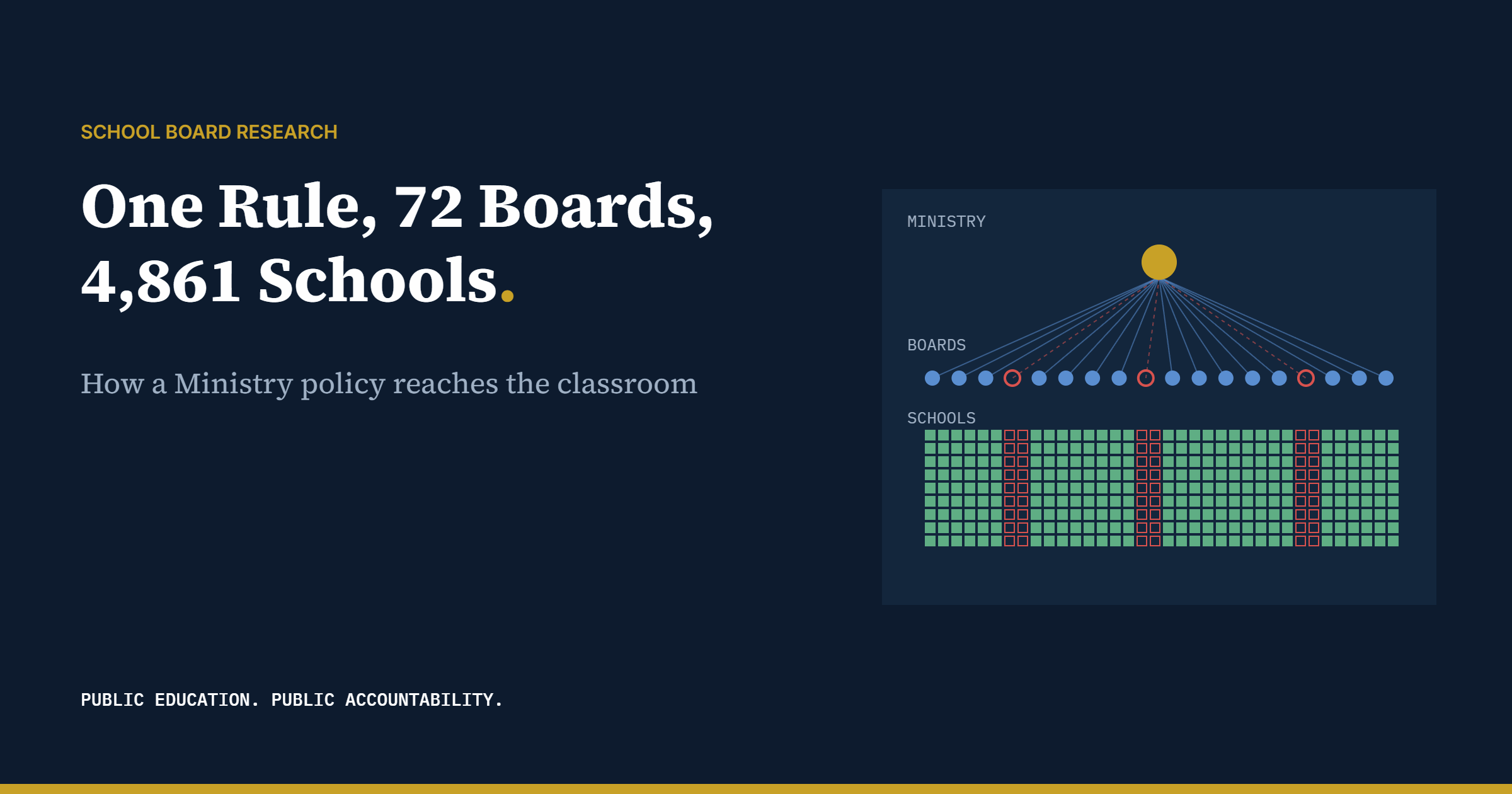
A rule written at Queen’s Park reaches a child only after a school board and a school act on it. This article follows one rule, the sign at the school entrance, from the Ministry to the door, and asks why there is no single place to see what each board has done with it.
Summary
Ontario’s Ministry of Education sets many of the rules for schools through policy/program memoranda. A memorandum does not reach a classroom on its own. It is written once, taken up by each of 72 district school boards in documents of their own, and put into practice in 4,861 schools. This article sets out that chain, uses one requirement of Policy/Program Memorandum 128 (PPM 128) to show where it can stop, and considers why the documents boards adopt are spread across 72 websites.
- A memorandum passes through two hand-offs before a student meets it: from the Ministry to a board, which writes its own policy and procedure, and from the board to its schools. In 2024-25 that meant 72 boards, 4,861 schools and 2,095,193 students.
- The sign at the school entrance is the simplest test of that chain. Since 1 September 2024, PPM 128 has required boards to post signage at school entrances, and it sets out the words of the sign. In School Board Research’s 2026 review, the code of conduct documents of six of 72 boards require the sign.
- The gap follows the age of the requirement. Two older requirements tested, that the code be publicly accessible and that it prohibit cyberbullying, are met by 71 and 62 boards. Four requirements that entered the memorandum in 2024 are met by 25, six, one and none. Forty-one boards publish documents dated on or after the 2024 reissue, and none of the 41 sets out a reporting route.
- There is no single place to read what the boards have adopted. The memorandum directs each board to publish on its own website. Nova Scotia publishes one provincial code for all of its public schools. PPM 128 asks boards to review their own documents; it is not clear from public sources what oversight the Ministry provides.
Results for each board are in the Ontario School Board Report Card (School Board Research 2026b).
1. Introduction
When the Ministry announces a rule, when does it apply in a child’s school? The answer depends on two steps that an announcement does not show. A memorandum is addressed to school boards. The board turns it into its own documents. The school puts those documents into practice. Each step is taken by different people, on a different timetable, and published in a different place.
This article describes that chain from public sources. It reports no new review results. The results it uses come from School Board Research’s 2026 review of codes of conduct, published in the Board Report Card and in an earlier article (School Board Research 2026d). It describes the sector as a whole and does not name boards.
2. How a memorandum travels

The Ministry of Education issues policy/program memoranda to school boards (Figure 1). PPM 128 sets out the Provincial Code of Conduct and is a policy of the Minister under section 301 of the Education Act. The current version was issued on 27 June 2024 and took effect on 1 September 2024 (Ontario Ministry of Education 2024).
The memorandum does not apply itself. It tells boards what they must do: “School boards must develop and update their own codes of conduct to implement, at minimum, standards consistent with this Provincial Code of Conduct” (Ontario Ministry of Education 2024). At the board, two kinds of document carry the rule. The trustees approve policy. Staff, under the director of education, write administrative procedures. The province’s governance guide for trustees draws the line in these words: a policy “articulates what must be done”, and a procedure “provides the details of how policies are to be implemented” (OPSBA and OESC 2022, 46). School Board Research’s guides on the difference between a policy, a procedure and a plan set this out in more detail (School Board Research 2026c).
At the school, the principal and staff act on the board’s documents. The school is where a parent or a child meets the rule, or does not. Table 1 sets out the chain.
| Level | Number, 2024-25 | Who acts | What it produces | Where a parent finds it |
|---|---|---|---|---|
| Ministry of Education | 1 | The Minister and the Ministry | The memorandum | ontario.ca |
| District school boards | 72: 31 English public, 29 English Catholic, 4 French public, 8 French Catholic | Trustees (policy); the director of education and staff (procedure) | The board’s own policy and procedure | The board’s website |
| Schools | 4,861: 3,976 elementary and 885 secondary | The principal and staff | Practice: signs, notices, responses to incidents | At the school |
| Students | 2,095,193 |
On average a board carries a rule to about 68 schools (4,861 ÷ 72 = 67.5) and about 29,100 students (2,095,193 ÷ 72 = 29,099.9). Boards range widely around that average. A single board that does not pass a rule on can leave dozens of schools, and tens of thousands of students, without it.
3. Where a rule can stop
A rule can stop at each hand-off in one of three ways. It can fail to arrive, where the board’s documents never take up the requirement. It can arrive changed, where words are left out, softened, or placed in a document parents are not directed to. It can arrive in name only, where a document is revised and given a new date but the new content is not added.
A fourth gap sits at the school. A board’s documents can be complete and practice can still differ from them. That gap cannot be seen in published documents, and School Board Research does not observe schools.
The gaps compound. Principals and staff work from their board’s documents, so a requirement missing from those documents is likely to be missing from the board’s schools as well. The first link can also fail. From 2012 until 2026 the Minister held the power to prescribe Ontario’s school climate survey and did not use it, leaving each board to draft its own (School Board Research 2026e).
The interactive figure below shows how these gaps add up across 72 boards and 4,861 schools. Its first view is the chain working as written; its second is the 2026 result for the entrance sign, discussed in section 4. The other views are illustrations.
Interactive
How far does a rule travel?
Choose a view or move the sliders. Each circle is a board and each square a school.
In School Board Research’s 2026 review, the code of conduct documents of six of 72 boards require the entrance sign PPM 128 sets out (documents read 22 and 23 September 2026). Those six boards have 269 schools and about 113,040 students (Ontario Ministry of Education, 2024-25). Schools were not observed: the school and student rows count schools and students by board, so they show how far the board documents carry the duty, not whether a sign is posted at any school.
Apart from the 2026 result, these views are illustrations, not findings. Schools are spread evenly across the 72 boards (about 68 each) and students in proportion to schools; real boards vary widely in size. Totals: 72 district school boards, 4,861 schools and 2,095,193 students, 2024-25 (Ontario Ministry of Education).
4. Case study: the sign at the school door
4.1 What the memorandum requires
The 2024 version of PPM 128 added a duty that a parent can check on the way into the building. It appears in a list of steps that boards must take:
“As a result, school boards must: […] post signage in school entrances and other visible places that reflects the behavioural expectations of the Provincial Code of Conduct. The required content of the sign is set out in Appendix A”
Appendix A then sets out the sign word for word (Figure 2). The only part a board supplies is its own name.

4.2 Why the sign is a fair test
Most requirements in a memorandum leave a board room to choose its words. This one does not. The Ministry wrote the sign, said where it goes, and left the board one blank to fill. If the chain works, the same seven expectations appear at the entrance of each school in the province. If it does not, the difference is visible from the sidewalk.
For a parent, the sign matters because it is the one part of the code of conduct a child sees without looking for it. It states the rule on personal mobile devices, that members of the school community will not “use a personal mobile device during class unless permitted by an educator”, and the rule on vaping, that they will not “use, share or sell vape, nicotine and/or tobacco products on school property”. It also tells a child what to do when something is wrong: “Speak with a staff member if you or someone else needs help.” A child who never reads the board’s code still reads the door.
4.3 What the 2026 review found
School Board Research’s 2026 review of codes of conduct tested whether each board requires its schools to post signage at school entrances and other visible places, with the content set out in Appendix A. The requirement was scored on the words of the board’s code of conduct and its implementation procedure, as published on board websites on 22 and 23 September 2026. Six of 72 boards met it (Figure 3; School Board Research 2026b, 2026d). Those six boards have 269 of the province’s 4,861 schools (5.5 per cent) and about 113,040 of its 2,095,193 students (5.4 per cent) (Ontario Ministry of Education 2019-2025a, 2019-2025b, 2026).

The result describes the first hand-off only. A school may post the sign although its board’s documents do not require it, and a board may have sent schools a sign by some route that does not appear in its published documents. What the result shows is that at 66 boards the published code of conduct documents do not tell a parent that the sign is required, and a principal working from those documents would not find the duty there.
4.4 Where the sign can be lost
Each hand-off offers its own way for the sign to go missing. These are descriptions of how the chain can fail. They are not findings about any board or school.
- Ministry to board. The memorandum is addressed to boards. A parent is unlikely to read it, so the parent depends on the board to pass the duty on.
- Board documents. The board’s code and procedure do not mention the sign, or the board produces its own version and a line is dropped or reworded.
- Board to school. No print-ready sign or direction reaches schools, and no record is kept of which schools have posted it.
- At the school. The sign is posted in the office rather than at the entrances, a poster made locally is used in place of the Ministry’s wording and leaves out some of the seven expectations, or a sign is taken down and not replaced.
5. The same pattern beyond the sign

The sign is not an isolated case. The 2026 review tested eight requirements of PPM 128, and Figure 4 shows six of them. Two have been in the memorandum since 2019 or earlier: that the board’s code of conduct is publicly accessible, and that it prohibits cyberbullying. They are met by 71 and 62 boards. Four entered the memorandum in 2024: an accessible format, the signage, availability in English and French, and a reporting mechanism. They are met by 25, six, one and none (Figure 4). The review reported that “The gap follows the age of the requirement. It does not follow the kind of board” (School Board Research 2026d).
The new requirements were not missed because the documents went unrevised. Forty-one boards publish documents dated on or after the 2024 reissue. None of the 41 sets out a reporting route, and six require the signage (School Board Research 2026d). This is the third way a rule can stop: the document is reopened, given a new date, and the new content is not added. A parent who checks the date on a board’s code and sees 2024 or 2025 cannot conclude that the code reflects the 2024 rules.
6. Why there is no single website
6.1 How it works now
A parent who wants to read a board’s code of conduct goes to that board’s website. The memorandum places publication there. It says that school boards must “make the codes of conduct policies and procedures available to the public, either on the school board’s website or, if the board does not have a website, in another accessible manner” (Ontario Ministry of Education 2024). The result is 72 versions on 72 websites, each with its own layout, its own titles and its own timetable for revision.
The Province publishes its own text in one place: the memorandum on ontario.ca, and the page at ontario.ca/SchoolRules to which the sign directs readers. What it describes is the provincial minimum. What a given board has adopted is found only on that board’s website.
6.2 Why it is built this way
Boards are separate bodies. Each district school board has its own elected trustees and its own policies. A memorandum sets a minimum, and the board writes the policy that applies to its schools.
Four systems, with constitutional protection. Ontario’s 72 boards are 31 English public, 29 English Catholic, 4 French public and 8 French Catholic boards (School Board Research 2026a). Denominational school rights (Constitution Act, 1867, s. 93) and minority language educational rights (Canadian Charter of Rights and Freedoms, s. 23) protect the Catholic and French-language systems, and in School Board Research’s view they are part of the reason boards keep control of their own documents.
Local detail differs. Contacts, reporting routes, procedures and school-level plans differ from board to board, and a board’s documents carry them.
No one has been given the task. The memorandum assigns publication to each board. School Board Research is not aware of any provincial requirement that board codes be published in a common format or collected in one place.
6.3 What one place would change
Much of the content is already provincial. The seven expectations on the sign are the same across Ontario; only the board name changes. The Provincial Code of Conduct sets the minimum standards that each board’s code must meet.
Families move. A parent who changes boards starts again, on a new website, with new titles for documents that do the same job.
Gaps would be visible. If each board’s current documents sat side by side with their dates, a missing line or an out-of-date version would be easy to see. The 2026 review had to find each board’s documents on its own website, often under a title that did not match its function (School Board Research 2026d).
Central publication already exists for data. The Ministry publishes board-level enrolment for all 72 boards in one catalogue (Ontario Ministry of Education 2019-2025a, 2019-2025b). Board policy documents have no equivalent.
6.4 Another model
Nova Scotia publishes a provincial policy that “establishes standards of behaviour for all Nova Scotia public schools” (Nova Scotia Department of Education and Early Childhood Development n.d.). A parent in that province reads one code. Nova Scotia’s school system is organised differently from Ontario’s, and its approach would not transfer without change, but it shows that a single provincial code is workable.
6.5 Who checks
PPM 128 places the duty to check on the boards themselves. It says that reviews of a board’s code of conduct policies and procedures “should occur at least every three years or more often if necessary”, and that “Reviews must assess the content of both the policies and procedures, ensuring they meet the requirements and expectations laid out in this document” (Ontario Ministry of Education 2024). It does not say whether the Ministry checks the result, how often, or what follows when a board’s documents fall short. School Board Research is not aware of any public account of the oversight the Ministry provides once a memorandum is issued.
One way it could work: if responsibility for each memorandum were assigned to a named member of Ministry staff, each responsible for two or three memoranda, checking each board’s published documents against them would be a manageable task. Because boards must publish their codes on their websites, the check can be done online. The 2026 review read the code of conduct documents of all 72 boards on 22 and 23 September 2026. This is an example of what oversight could look like, not a description of how the Ministry is organized.
7. What a parent can do
- Look at the entrance of your child’s school. If there is a sign, compare it with Figure 2. The Ministry sets the words, so the sign should carry all seven expectations and the two closing lines.
- If there is no sign, ask the principal where the sign required by PPM 128 is posted.
- Look up the board in the Board Report Card. Requirement 8 shows whether the board’s documents require the sign, with the board’s own words and a link to the document.
- Write to your trustee. A parent can write to an elected trustee at any time and does not need the school’s permission to do so.
- If a result looks wrong, or a concern has been raised with the board before, use the public report form. Boards may use the board response form to ask for a review of a result.
8. Data, method and limitations
Counts. The numbers of boards, schools and students are the Ministry of Education’s figures for 2024-25, as of 17 October 2025 (Ontario Ministry of Education 2025). The division of boards into four systems is from School Board Research 2026a. The averages per board in section 2 are simple division and do not describe any particular board.
Review results. The results in sections 4 and 5 are from School Board Research’s 2026 review of codes of conduct at all 72 district school boards, documents read on 22 and 23 September 2026, as published in the Board Report Card and in School Board Research 2026d. Each requirement was scored met or not met against a written method, available on request.
Figures. Figure 1 is a diagram. The interactive figure in section 3 spreads schools evenly across boards and students in proportion to schools; apart from its 2026 signage view, its views are illustrations. Boards are drawn the same size although they range widely in size. Figure 3 and the 2026 view of the interactive figure count schools and students by board: the schools are those of the six boards whose documents require the sign (Ontario Ministry of Education 2026), and the students are those boards’ enrolment as published by the Ministry, rounded to the nearest five (Ontario Ministry of Education 2019-2025a, 2019-2025b). Schools were not observed, so these counts show how far the board documents carry the duty, not whether a sign is posted at any school. The provincial totals of 4,861 schools and 2,095,193 students include four schools run by school authorities outside the 72 boards. Figure 4 shows six of the eight requirements tested. The two not shown are the implementation procedure, required since 2019 or earlier with a documentary record added in 2024, and the currency of the documents, which turns on the date of the 2024 reissue. Both are reported in School Board Research 2026d.
Limitations. The review reads published documents. It does not observe schools, and a school may post the sign although its board’s documents do not require it. The ways the chain can fail in sections 3 and 4.4 describe how a rule can be lost; they are not findings about any board or school. Section 6 is School Board Research’s analysis. The quotations from PPM 128 were read on ontario.ca on 24 October 2026. Large language models were used to assist with retrieval and drafting. Quotations and figures were checked against their sources.
Board names. This article describes the sector and names no board. Board-level results are published in the Report Card, where each can be read with its evidence.
References
Canadian Charter of Rights and Freedoms, s. 23, Part I of the Constitution Act, 1982. https://laws-lois.justice.gc.ca/eng/Const/page-12.html
Constitution Act, 1867, 30 & 31 Vict., c. 3 (U.K.), s. 93. https://laws-lois.justice.gc.ca/eng/Const/page-4.html
Education Act, R.S.O. 1990, c. E.2, s. 301. https://www.ontario.ca/laws/statute/90e02
Nova Scotia Department of Education and Early Childhood Development. n.d. “Provincial School Code of Conduct Policy.” Accessed 24 October 2026. https://www.ednet.ns.ca/school-safety/code-of-conduct
Ontario Ministry of Education. 2019-2025a. Enrolment by Grade in Elementary Schools, 2018-19 to 2024-25. Ontario Data Catalogue. https://data.ontario.ca/dataset/enrolment-by-grade-in-elementary-schools
Ontario Ministry of Education. 2019-2025b. Enrolment by Grade in Secondary Schools, 2018-19 to 2024-25. Ontario Data Catalogue. https://data.ontario.ca/dataset/enrolment-by-grade-in-secondary-schools
Ontario Ministry of Education. 2024. Policy/Program Memorandum 128: The Provincial Code of Conduct and School Board Codes of Conduct. Issued 27 June 2024; effective 1 September 2024. https://www.ontario.ca/document/education-ontario-policy-and-program-direction/policyprogram-memorandum-128
Ontario Ministry of Education. 2025. “Facts about elementary and secondary education.” Data for the 2024-25 school year as of 17 October 2025. https://www.ontario.ca/page/facts-about-elementary-and-secondary-education
Ontario Ministry of Education. 2026. Number of Elementary and Secondary Schools by School Board/School Authority, 2024-2025. Ontario Data Catalogue. https://data.ontario.ca/dataset/number-of-elementary-and-secondary-schools-by-school-boardschool-authority
OPSBA and OESC. 2022. Good Governance: A Guide for Trustees, School Boards, Directors of Education, and Communities, 2022-2026. https://www.opsba.org/wp-content/uploads/2023/01/EN_Good-Governance-Guide-2022-2026_en_aoda_final.pdf
School Board Research. 2026a. “Growth at the Top, Decline at the Door: What Ontario’s Enrolment Data Show.” 16 September. https://schoolboardresearch.ca/2026/09/16/ontario-enrolment-growth-at-the-top-decline-at-the-door/
School Board Research. 2026b. Ontario School Board Report Card. https://schoolboardresearch.ca/board-report-card/
School Board Research. 2026c. “Policy, Procedure or Plan: Two New Guides Explain the Difference.” 28 September. https://schoolboardresearch.ca/2026/09/28/policy-procedure-or-plan-two-new-guides/
School Board Research. 2026d. “Updated, Not Implemented: What 72 School Board Codes of Conduct Still Leave Out.” 20 October. https://schoolboardresearch.ca/2026/10/20/updated-not-implemented-codes-of-conduct/
School Board Research. 2026e. “What Happened to Ontario’s School Climate Surveys.” 6 October. https://schoolboardresearch.ca/2026/10/06/what-happened-to-ontarios-school-climate-surveys/
Legal disclaimer. School Board Research is not a law firm, its researchers are not lawyers, and nothing in this article is legal advice. The results are research findings about documents published on board websites, read against a written method, available on request, on the dates stated. They are not findings that any board has contravened the Education Act, Policy/Program Memorandum 128 or any other law; only a regulator, the Ministry or a court can make that finding. A reader who needs advice about their own situation should consult a lawyer.
School Board Research publishes independent analysis of Ontario school board data and policy. We are not lawyers, and nothing in this publication is legal advice. If you identify an error, please write to info@schoolboardresearch.ca. Corrections are noted on the page where they are made.
Leave a Reply