
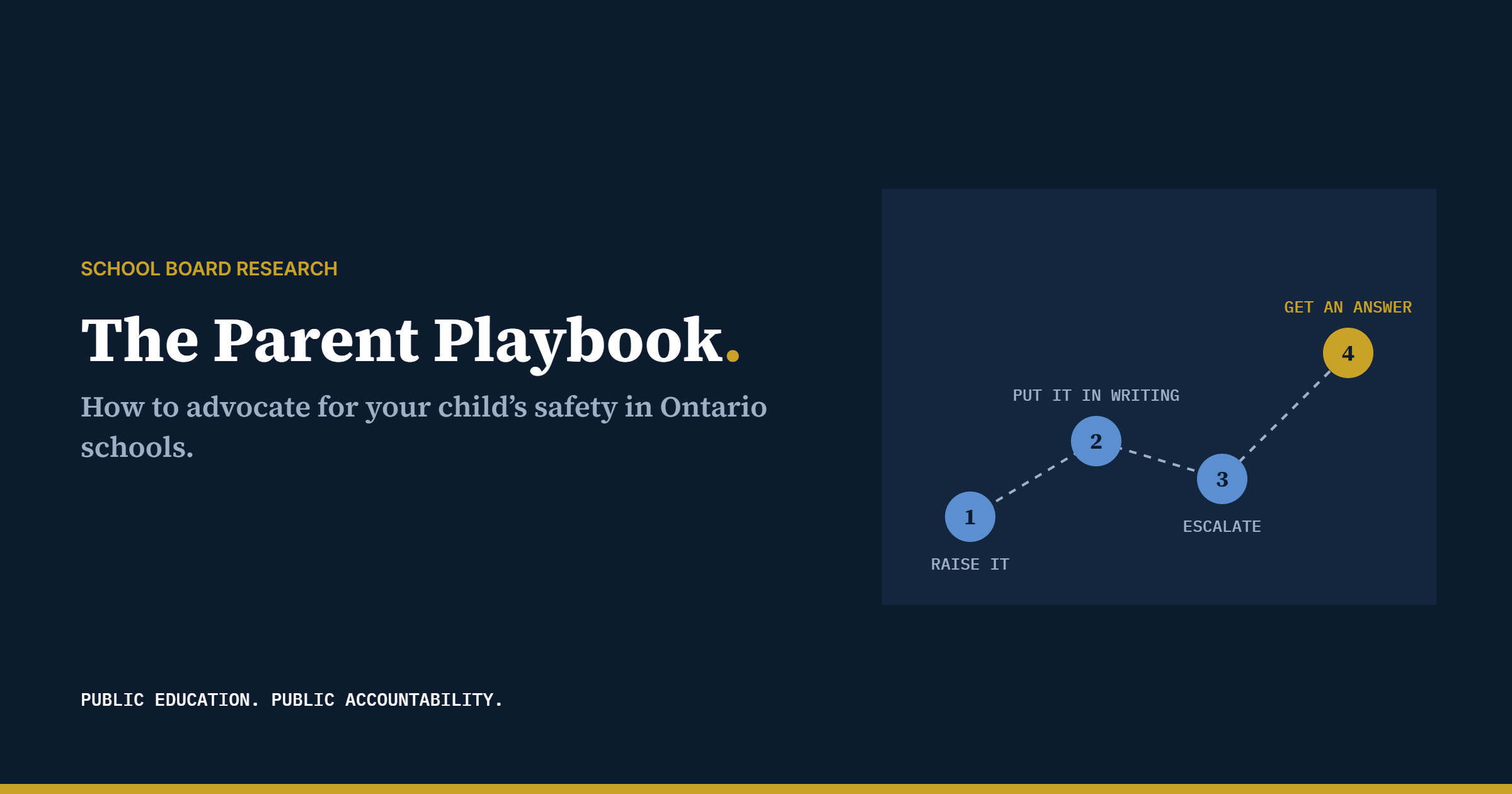
For many parents, the system does not make it easy to raise a safety concern. That is not speculation — it is one of the most consistent findings from the research conducted by School Board Research and the investigations documented by the Hold Schools Accountable Parent Network (HSA).
Across Ontario, parents who raise safety concerns about their children’s schools describe a common experience: being redirected between administrators and superintendents, receiving vague verbal assurances that disappear without documentation, and encountering bureaucratic structures that wear them down rather than resolve their concerns. The pattern is consistent enough that it is hard to attribute to isolated missteps. When boards lack transparent reporting mechanisms — and School Board Research’s 2025 pilot study found that 82% of the boards it assessed did lack them[1] — the effect is to isolate parents and make accountability harder to achieve.
But parents are not powerless. The provincial policy framework gives families defined rights, and the tools for exercising those rights are more accessible than many parents realize.
Watch: The Parent Playbook — 4 Tips to Navigate the School Board Maze
In this segment from his investigative series on 640 Toronto Radio, Anwar Knight shares four strategies for parents advocating within the school system. The advice is grounded in his own experience and in conversations with families across the province: put everything in writing, know the standards your school is required to meet, keep a paper trail, and always CC the appropriate people.[2]
Watch: For 7 Hours a Day, Do You Know What Is Happening to Your Kids?
A brief but pointed message about the gap between what parents assume is happening in schools and what the evidence reveals.[3]
Watch: No More Cover-Ups — Campaign Update
In this campaign update, Anwar Knight reports on HSA’s meeting with Premier Ford and Minister of Education Paul Calandra, the growing momentum behind the petition to amend the Education Act, and the increasing number of families and educators joining the movement for transparency in Ontario schools.[4]
Your Toolkit: What Every Ontario Parent Should Know
1. Know the provincial safety directives. Three Policy/Program Memoranda form the backbone of Ontario’s safe schools framework: PPM 128 (codes of conduct),[5] PPM 144 (bullying prevention and intervention),[6] and PPM 145 (progressive discipline).[7] These are not optional guidelines — they are mandatory directives that every board must implement. Our Safe Schools Policies page provides parent-friendly summaries of what each PPM requires.
2. Put everything in writing. If it is not documented, it did not happen. Schools rely on informal verbal exchanges precisely because they leave no record. After any conversation with school staff about a concern, send an email summarizing what was discussed. Copy the principal, the superintendent, and if warranted, the director of education.
3. Request your board’s policies. Every board is required to have local policies implementing the provincial directives. Ask for them. If they are not publicly posted on the board’s website, that is itself a compliance issue. School Board Research’s audit found that 18% — 11 of 60 boards — did not make both their code of conduct policies and procedures accessible online.[1]
4. Use MFIPPA. The Municipal Freedom of Information and Protection of Privacy Act gives Ontario residents the right to request records from school boards.[8] This includes incident reports, investigation findings, communications, and financial records. A formal access request creates a legal obligation for the board to respond within 30 days.[8]
5. Connect with other families. The consistent finding from both SBR’s research and HSA’s investigations is that isolated families are easier to dismiss. Parents who connect, share information, and advocate collectively create the conditions for accountability. The Hold Schools Accountable Parent Network is one platform for doing exactly that, and the petition to amend the Education Act has gathered signatures from parents across the province.[4]
6. Watch for our Board Report Card. School Board Research is preparing a Board Report Card that will let parents look up how a representative sample of their board’s published policy clauses compares against provincial requirements. It is launching soon — until then, the fastest way to check your own board is to request its code of conduct directly (see the steps above) and confirm it is posted publicly.
The Movement Is Growing
HSA’s meeting with Premier Ford and Minister Calandra marks a significant step in bringing these issues to provincial attention.[4] The petition to amend the Education Act — requiring boards to provide parents with anonymized investigation reports for serious incidents — addresses one of the most fundamental transparency gaps in the current system.[9] Combined with the evidence from School Board Research’s policy audits, the case for reform is grounded not in emotion but in data.
Public schools, public accountability. That is the principle. And the evidence shows it is long overdue.
Sources
[1] School Board Research, PPM 128 Pilot Study — Selected Code of Conduct Clauses, 60 English-Language Ontario School Boards, review period June–August 2025. The audit found 82% of boards (49 of 60) did not communicate how members of the school community could report unacceptable behaviour, and 18% (11 of 60) did not make both their code of conduct policies and procedures publicly accessible online.
[2] Anwar Knight, “The Parent Playbook — 4 Tips to Navigate the School Board Maze,” Hold Schools Accountable Parent Network / 640 Toronto Radio, December 11, 2025. Video.
[3] Hold Schools Accountable Parent Network, “For 7 Hours a Day, Do You Know What Is Happening to Your Kids?,” October 22, 2025. Video.
[4] Anwar Knight, “No More Cover-Ups — Campaign Update,” Hold Schools Accountable Parent Network, July 17, 2025. Video. Knight reports an in-person meeting at the Premier’s office with Premier Ford and Minister of Education Paul Calandra, attended by Knight and two other HSA parent network families. Petition described as having “thousands” of signatures at time of recording.
[5] Ontario Ministry of Education, Policy/Program Memorandum 128: The Provincial Code of Conduct and School Board Codes of Conduct, effective September 1, 2024.
[6] Ontario Ministry of Education, Policy/Program Memorandum 144: Bullying Prevention and Intervention, issued November 25, 2021.
[7] Ontario Ministry of Education, Policy/Program Memorandum 145: Progressive Discipline and Promoting Positive Student Behaviour, effective October 17, 2018.
[8] Municipal Freedom of Information and Protection of Privacy Act, R.S.O. 1990, c. M.56. Ontario e-Laws. The right to request records is established under Part I of the Act. The 30-day response requirement is in s. 19; the time limit begins from the date a complete request is received. See also Ontario, “Chapter 6: Managing the Request Process,” Freedom of Information and Protection of Privacy Manual.
[9] Hold Schools Accountable Parent Network, petition to amend the Education Act (R.S.O. 1990, c. E.2) to require boards to provide parents with anonymized investigation reports for serious incidents. Details available at holdschoolsaccountable.ca.
Legal disclaimer. School Board Research is not a law firm, its researchers are not lawyers, and nothing in this article is legal advice. The results are research findings about documents published on board websites, read against a written method, available on request, on the dates stated. They are not findings that any board has contravened the Education Act, Policy/Program Memorandum 128, Policy/Program Memorandum 144 or any other law; only a regulator, the Ministry or a court can make that finding. A reader who needs advice about their own situation should consult a lawyer.
School Board Research is an independent, evidence-based research initiative examining how Ontario’s 72 publicly funded school boards translate provincial safety mandates into local policy. Learn more at schoolboardresearch.ca.
Leave a Reply